Investigations
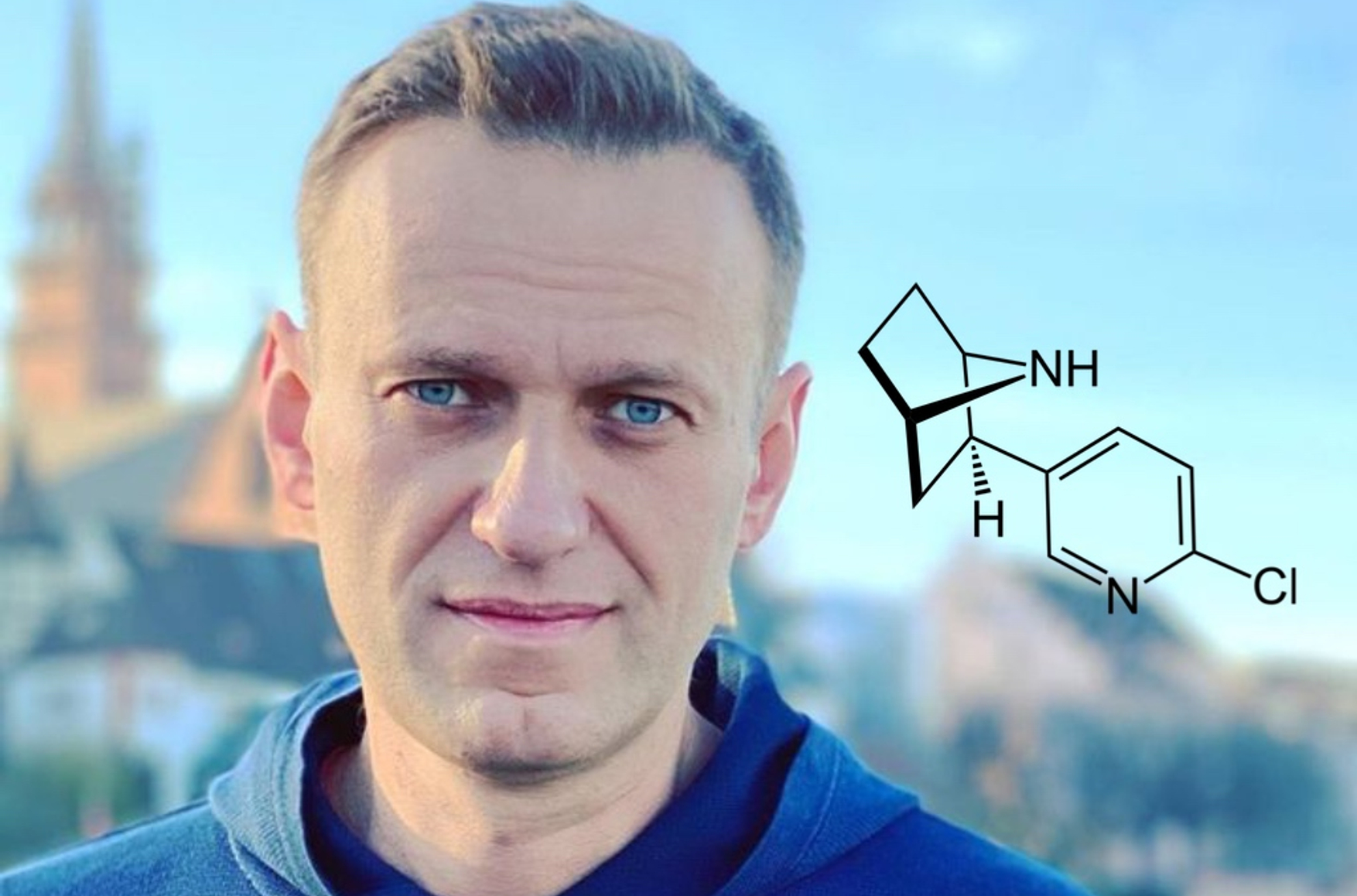
General Vladimir Kondratyev, the director of Russia’s State Research Institute of Organic Chemistry and Technology (GosNIIOKhT), published a paper in 2014 on the testing of epibatidine, the toxin used to poison Alexei Navalny. The trials were ostensibly conducted to determine epibatidine’s analgesic effect, but the content of the article suggests that research actually focused on methods for detecting the substance. Around the time of Navalny’s attempted assassination with Novichok in 2020, Kondratyev was in constant contact by phone with one of the poisoners. Navalny survived that earlier poisoning thanks to the quick work of Russian paramedics, who administered the nerve agent antidote atropine after seeing his symptoms. According to chemists, epibatidine was chosen for his murder in 2024 precisely because it was the only thoroughly tested substance with no known antidotes.
In 2013–2014, the GosNIIOKhT research institute published two papers on epibatidine. The first focused on synthesizing the poison, while the second dealt with testing its effects on the body. The second paper, titled “Non-Opioid Analgesics. Analytical Support of Preclinical Trials of Endo-Epibatidine,” was ostensibly meant to study the substance’s pain-relieving properties. In reality, however, only a few lines were devoted to its analgesic effect. Instead, the bulk of the article examined the toxic qualities of epibatidine — its impact depending on the route of administration, and even more conspicuously, methods for detecting it in the body.
Here is how the paper describes the toxic effect of the substance:
“The clinical picture of intoxication was characterized by the following symptoms: motor agitation, tremor, rapid breathing (shortness of breath as a compensatory response indicating respiratory distress), prostration, convulsions, lateral recumbency, opisthotonus, respiratory arrest, and death. The development of intoxication symptoms was rapid, occurring within 10–30 seconds, while a reduction in symptoms was observed after 30 minutes. After that, the animals exhibited brief convulsions or none at all. The animals remained lethargic, with ataxia and adynamia for several hours. By the following day, the animal’s condition did not differ from the baseline.”
The article also discusses in detail, complete with tables, methods for testing blood plasma for the presence of epibatidine — something that would seemingly have no connection to its pain-relieving effect. According to scientific experts, the authors’ genuine interest in the substance was clearly not medical in nature. This view is shared by intensive care physician Alexander Polupan, who resuscitated Navalny after he was poisoned in 2020:
“Despite the stated relevance of the study, which was framed as an examination of epibatidine’s analgesic potential, a significant portion of the empirical material focuses on analyzing its pharmacokinetics under different routes of administration (intramuscular and transdermal), manifestations of toxic effects, and the possibilities for laboratory detection of the substance in blood plasma using various analytical methods. In this regard, the clinical focus and practical expediency of the work raise questions. The results presented primarily characterize the parameters for achieving toxicologically significant concentrations of the compound and the time windows for its detection. Such a shift in research emphasis creates the impression that the authors’ applied interest was predominantly concentrated on the toxicokinetic and detection-related aspects of the substance rather than on its clinical applications.”
A Russian chemist who is well acquainted with the authors of the study and who participated in the development of similar substances agrees with Polupan’s conclusions. He also explained why this particular toxin was chosen for use against Navalny:
“Institutes like GosNIIOKhT are traditionally headed either by military personnel or by people closely connected to the military. They have little interest in medical aspects, and all research is invariably focused on potential applications for the military or special services. In this case, it is immediately clear that the study does not examine analgesic properties, but rather seeks to establish the threshold for detecting the poison and the period of time after which it becomes unidentifiable. In other words, the authors were apparently interested in the potential use of this poison.
I'm acquainted with most of the authors: Stankov is the head of the analytical department, Kondratyev was then the director of GosNIIOKhT, Derevyagina and Dvoretskaya are analysts, and Pavel Kazakov is the deputy for science. I don’t know Semchenko — he must be from some medical institute, apparently included to justify the supposed ‘pharmaceutical’ purpose of the study.
Apparently, the epibatidine was not produced at GosNIIOKhT, but at Signal [The Insider previously wrote about how SC Signal became the main supplier of neurotoxins for Russia’s security services]: the Diels–Alder reaction, amino group protection, and cyclization are all Babkin’s area of expertise, while the production of carfentanil using palladium on carbon could have been done by Sergei Galan. So I am almost certain that this was carried out at the Signal center, but at that time Signal either didn’t have a base for preclinical trials or lacked personnel, so the work was outsourced to GosNIIOKhT.
The choice of epibatidine is perfectly clear to me: it has a bicyclic ring, and bicyclic compounds have no antidotes. In other words, they wanted to guarantee a lethal outcome. There are other bicyclics, of course, but their toxicity in humans is underresearched. Had they used something like bicycloheptane or bicyclononane, sure, it might thin the blood, but whether the subject would die — or survive, like he did in 2020 — would be completely unpredictable.
I think most likely the poison was mixed into food. Topical application is very difficult to dose, and in water it might produce a strange taste or a slight color change, but in prison food it would have gone unnoticed.”
One of the epibatidine paper’s co-authors, General Vladimir Kondratyev (the head of GosNIIOKhT at the time) is a chemical weapons expert. His institute not only contributed to the development of the Novichok nerve agent — as phone records show, in the days of Navalny’s poisoning with Novichok in August 2020, Kondratyev was regularly in contact with Artur Zhirov, the director of SC Signal, who personally synthesized the batch of Novichok used by FSB operatives and consulted with the assassins in real time on the day of the poisoning.

After Navalny’s death in a penal colony in the Russian Arctic in 2024, The Insider uncovered documents confirming that he had exhibited symptoms of poisoning in his final hours: severe abdominal pain, vomiting, convulsions, and loss of consciousness. According to experts, these are precisely the symptoms that would be expected from poisoning with epibatidine. On Feb. 14, 2026, the United Kingdom, Sweden, France, Germany, and the Netherlands issued a joint statement confirming that their laboratories had detected precisely this neurotoxin in Navalny’s biological samples.
К сожалению, браузер, которым вы пользуйтесь, устарел и не позволяет корректно отображать сайт. Пожалуйста, установите любой из современных браузеров, например:
Google Chrome Firefox Safari