News
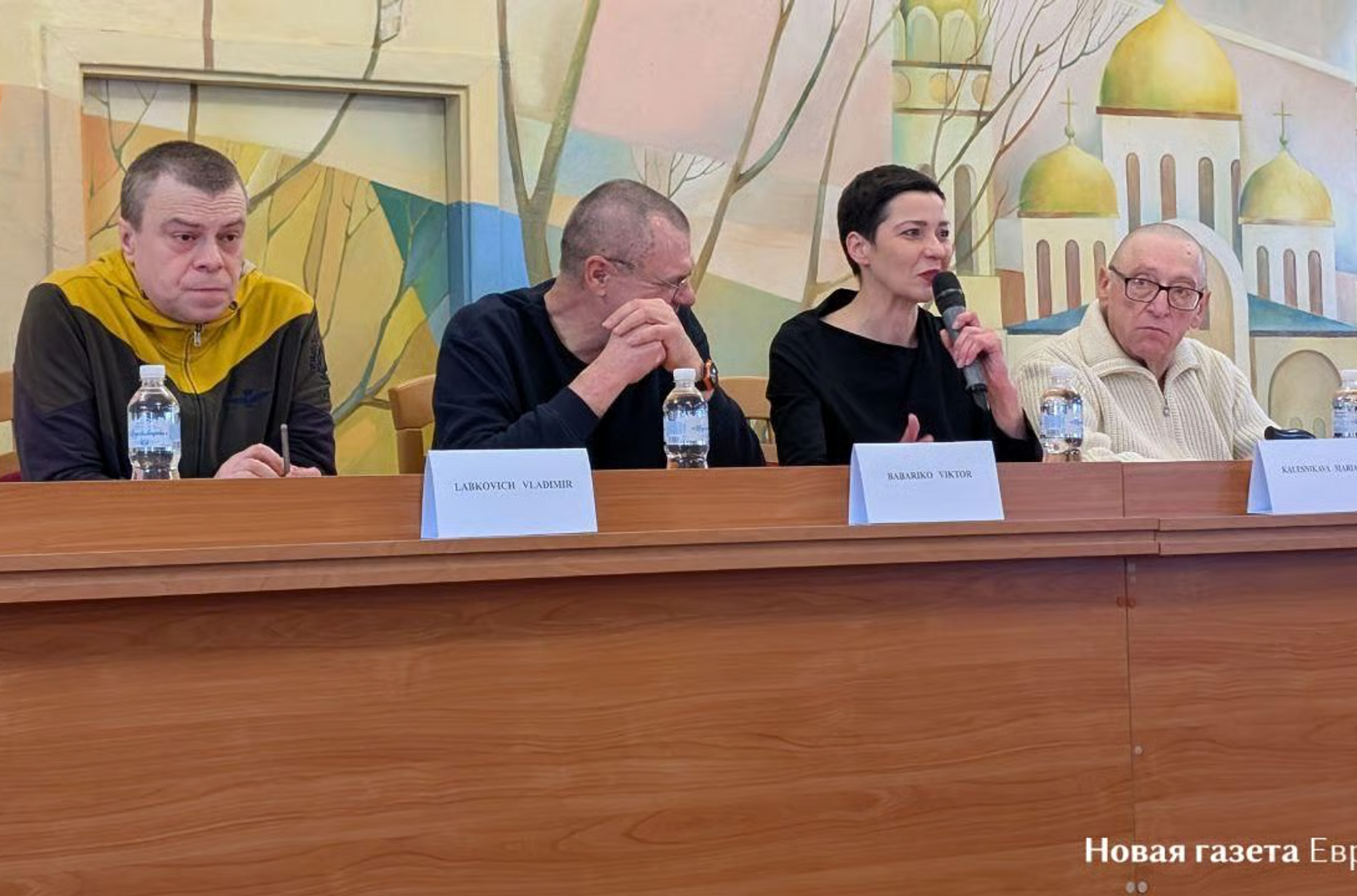
Former political prisoners Viktar Babaryka, Maria Kalesnikava, Uladzimir Labkovich and Aleksandr Feduta speak at a press conference in Chernihiv. Photo: Novaya Gazeta Europe
A group of former Belarusian political prisoners who were pardoned by Alexander Lukashenko and taken to Ukraine held a Dec. 15 press conference at a hospital in Chernihiv. There was no live broadcast of the event, and the exact location was withheld due to security concerns, with Ukraine fearing a potential Russian attack on the venue had it been disclosed. Among those who spoke were former presidential contender Viktar Babaryka, his 2020 campaign manager Maria Kalesnikava, Viasna human rights lawyer Uladzimir Labkovich, and political analyst Aleksandr Feduta, according to a report by the independent Russian publication Novaya Gazeta Europe.
As part of a deal brokered by the U.S., the former prisoners were freed in exchange for the lifting of sanctions on Belarusian exports of potash, a key component in fertilizers. The deal resembled similar agreements between Washington and Minsk that had occurred in recent months, most prominently the release of 52 political prisoners in November, which was accompanied by the relaxation of Western restrictions on the activities of state-owned airline Belavia.
Alexander Lukashenko’s press secretary Natalia Eismont confirmed that the latest release took place as part of a deal, adding that over 100 people were sent to Ukraine in exchange for wounded Russian citizens and captured Belarusian POWs. Eismont also said the U.S. evacuated nine foreign nationals and explained that the decision to release the political prisoners was made in part in response to appeals from the POWs’ relatives for an exchange.
The group of released political prisoners said they had no idea they were being taken to Ukraine until their arrival. Babaryka said he tried to navigate by the sun while being transported and believed he was being taken to the city of Brest in southwest Belarus.
The group said they were released without passports.
“We were taken out without papers. We were given a release certificate — an A4 sheet with a photo, passport details, and a note saying we were freed. We are very grateful to the Ukrainian side for accepting us without documents. We are grateful for the way our arrival was arranged — everything was warm, comfortable and welcoming. We understand how difficult and important this is under the conditions Ukraine faces now,” the human rights lawyer Labkovich said.
Former presidential contender Babaryka declined to comment on the war in Ukraine, saying prisoners in his colony had no access to independent media.
“Where we were held, access to information was extremely limited. We received information only from Belarusian state media — whether it is truthful or not, it was one-sided. Therefore, commenting or making judgments while knowing only one side makes no sense. On everything happening in the outside world — especially where there is more than one side and many disputed issues — you will not hear much from us now,” he said.
Kalesnikava, who managed Babaryka’s 2020 election campaign, declined to answer questions about Belarusians fighting on the Ukrainian side, expressing sympathy for victims of the war and stressing her support for ending the conflict. Babaryka said individuals make their own choices based on conviction. Political analyst Feduta called it hypocritical to support such a choice without being ready to fight alongside them, adding that he cannot fight due to health issues. The lawyer Labkovich said he understands the decision of Belarusian volunteers and supports ending the war.
As for the conditions in Belarusian prison, Babaryka said he began losing consciousness sporadically in 2023. After one such incident, he woke with broken ribs, 23 cuts, and a damaged lung. He said he still does not know what happened. After fluid was drained from his lung and he was moved to a national hospital, the fainting spells stopped. His son, Eduard, remains in a strict-regime colony in Orsha on charges of tax evasion and “abetting mass unrest.”
Feduta’s health also worsened in custody. He spent his last six weeks in the colony’s infirmary and had surgery scheduled for Feb. 24. He was not allowed to gather his belongings, and his manuscripts were confiscated. “There were no political notes, no diaries, nothing about my imprisonment. It was a film script, two plays, and two notebooks of poems,” he said.
Kalesnikava, who is also a professional flutist, thanked those who supported her during her imprisonment and those who took part in securing her release, including Ukrainian President Volodymyr Zelensky and U.S. President Donald Trump. In September 2020, Belarusian authorities attempted to forcibly deport Kalesnikava, but she tore her passport, refused to leave the country, and was arrested. In 2021, a Minsk court sentenced her to 11 years in prison on charges of “conspiracy to seize power,” “creating an extremist organization,” and “calls to actions harming national security.” She said she does not regret refusing to flee Belarus in 2020 even at the cost of her freedom.
“I thank my family — through bars and miles of distance I felt the support of my father, my sister, musicians, and all those in the arts who supported me. I thank everyone from the bottom of my heart, everyone involved, because we are here together, because we are free… This difficult choice was very easy for me, because I was and remain completely certain that I stood for the right idea, that I stood for my values, the same values expressed by Viktar and Eduard Babaryka. There are many of us — I am not alone. And even now, after tremendous trials and suffering, which for me have partly ended but for many continue — I always remember this. I still believe that in turning-point moments, if you can, you must,” she said.
Kalesnikava also said she worked in the colony’s sewing workshop making uniforms. “The conditions were such that I stand before you relatively healthy. They are very difficult, but even in them one can find ways to sustain oneself.”
The independent Belarusian outlet Belsat, citing Ukraine’s Coordination Headquarters for the Treatment of POWs, reported that released Belarusians who wish to remain in Ukraine may do so, while others will be able to travel to the EU on Tuesday. The headquarters said only “a small percentage” of those released lack passports, and efforts are underway to determine where their documents are.
On Saturday, Belarus released a total of 123 prisoners in exchange for the lifting of sanctions on Belarusian potash exports. Of those, 114 were transported to Ukraine — 104 Belarusians and five Ukrainians. Some prominent political prisoners, including Ales Bialiatski, founder of the human rights group Viasna, were taken to Lithuania. Bialiatski won the 2022 Nobel Peace Prize in a joint award with the Russian human rights organization Memorial and the Center for Civil Liberties from Ukraine.
Trump envoy John Coale told Reuters he believes the roughly 1,000 political prisoners still held in Belarus could be released — ideally in a single large group — in the coming months.
“I think it’s more than possible that we can do that, I think it’s probable... We are on the right track, the momentum is there,” he said.
Coale added that if no political prisoners remained, most sanctions on Belarus could be lifted, calling it “a fair trade.”